🔵
Road Rash
1994
.png)
SEGA-GENESIS
8.7
The complete collection of 336 vintage action games — with full reviews, cheat codes, and trivia.
.png)
BlueSky Software's 1994 Genesis RPG-action game based on the Shadowrun tabletop RPG — completely different from the SNES Shadowrun, this version follows Joshua, a street samurai in a cyberpunk Seattle, through a third-person action-RPG perspective with a contract-based mission structure, hacking, magic, and a more open-ended approach than the SNES linear narrative.
.png)
Dimps' 2002 GBA sequel to Sonic Advance — Sonic Advance 2 features five playable characters (Sonic, Tails, Knuckles, Amy, Cream), new Trick system for aerial maneuvers, and eight zones with faster speed than its predecessor. The middle entry in the GBA Sonic Advance trilogy and the series high point for many players due to its faster pace and character variety.
.png)
The first Sonic game developed for a Nintendo platform, Sonic Advance brought the blue blur to Game Boy Advance in 2001 with a return to 2D side-scrolling gameplay. Four playable characters (Sonic, Tails, Knuckles, Amy), seven zones with multiple acts each, and tight responsive controls made it the best Sonic game since the Genesis era for many players.
.png)
Factor 5's landmark N64 flight action game — pilot iconic Star Wars vehicles across 16 missions recreating battles from the original trilogy, with an Expansion Pak mode that pushed N64 hardware to its visual limit.
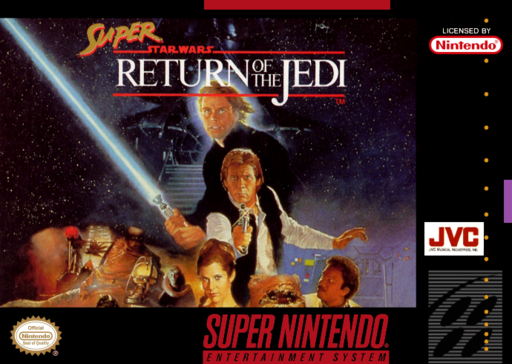
JVC's 1994 SNES action-platformer and the conclusion of the Super Star Wars trilogy — Super Star Wars: Return of the Jedi expands the playable roster to four characters (Luke, Han, Leia, Wicket the Ewok), adapts Episode VI's Tatooine desert, Endor forest, and Death Star II locations with Mode 7 vehicle sequences for the speeder bike chase and Millennium Falcon run, and delivers the series' largest character variety.
.png)
Sony's answer to Metal Gear Solid: a third-person action-stealth game starring covert operative Gabe Logan investigating the Syphon Filter virus. More action-oriented than Konami's game, with memorable taser-on-fire mechanics and a solid PS1 exclusive that spawned multiple sequels.

Capcom's 1993 beat-em-up arcade game featuring Marvel's Punisher — The Punisher and Nick Fury fight through seven stages of organized crime in the most gun-focused beat-em-up Capcom produced, using the same CPS-1 engine as Final Fight with firearms as primary weapons, grenades, and the series' most overtly violent combat.
.png)
Capcom's 1993 SNES beat-em-up — Alien vs. Predator is not the arcade game but a distinct SNES-exclusive action game where players control Dutch Schaefer or Linn Kurosawa fighting Aliens across seven stages. Two-player co-op, weapons including plasma cannon and smart discs, and dark action that captures the sci-fi horror tone.

SNK's 1994 Neo Geo sequel and the definitive Art of Fighting experience — Art of Fighting 2 dramatically expands the roster to 12 characters (from 2+2 boss-only in AOF1), adds Robert Garcia, Yuri Sakazaki, and King as fully playable alongside refined special move systems, improves the Spirit Gauge balance, and develops the franchise's story connecting to Fatal Fury's timeline.
.png)
The PS1 open-city driving game that bridged OutRun and Grand Theft Auto. Driver's four-city sandbox, 70s car chase film aesthetic, and cinematic replay editor created an experience that felt uniquely adult on PS1 hardware — its undercover cop narrative and chase mechanics made it the most compelling open-world driving game before GTA III.
.png)
Treasure's creative Genesis platformer where protagonist Heady throws his detachable head to attack, solve puzzles, or swap with special heads granting unique powers. Dynamite Heady's constant mechanic variation, inventive level designs, and technical achievement make it one of the Genesis's most creative and underrated games.
.png)
Capcom's 1990 Game Boy RPG-platformer hybrid where Firebrand the gargoyle — villain of the Ghosts 'n Goblins series — becomes the hero of his own adventure. Gargoyle's Quest blends overhead RPG-world exploration with side-scrolling action stages and a progression system that grows Firebrand's wings, fire breath, and wall-clinging abilities.
.png)
The arcade sequel that improved on Golden Axe in every dimension — four-player simultaneous play, larger sprites, more varied enemy types, and rideable creatures with unique attacks. Golden Axe: The Revenge of Death Adder was arcade-only in most regions, making it one of the great hidden gems in the Golden Axe franchise.

SNK's 2000 Neo Geo fighting game and the second chapter of the NESTS Chronicles — The King of Fighters 2000 expands the Striker System to two Strikers per team (from KOF '99's one), features the largest KOF roster to that point, introduces Ramon and Vanessa as new characters, continues the K' and NESTS story arc, and runs on the powerful NESTS team with expanded boss encounters.
.png)
HAL Laboratory's 2004 GBA Kirby game with a unique open-world Metroidvania structure — instead of linear stages, the Amazing Mirror world is a single interconnected map of ten areas accessible in non-linear order, requiring Kirby to backtrack with new abilities to reach previously inaccessible sections. Features four-player simultaneous multiplayer via Game Boy Advance link cable with four Kirbys of different colors.
.png)
Mega Man 4 introduced the Mega Buster charge shot that became the series standard — alongside eight new Robot Masters, the villainous Dr. Cossack, and one of the NES's most polished action-platformer entries.
.png)
Capcom's 1997 PS1 Mega Man entry — Mega Man 8 features anime-quality cutscenes, eight Robot Masters including the fan-favorites Tengu Man and Frost Man, the Rush Super Adapter's return, and one of the franchise's most distinct visual presentations. Polarizing due to cutscene quality but admired for stage design and Mega Man legacy.
.png)
The first entry in Quintet's soul trilogy — Soul Blazer has the player acting as an angel defeating demons and restoring souls to a corrupted world, resurrecting villagers and NPCs as enemies are cleared.
.png)
Nintendo's 1990 NES action-adventure exclusive — StarTropics follows Mike Jones through tropical island dungeons to rescue his uncle, blending Zelda-style puzzle-dungeon exploration with baseball-throw combat in a contemporary Pacific Island setting. One of the few Nintendo-developed NES games never released in Japan.

Nintendo's GBA launch title and Super Mario Bros. 2 remake — Super Mario Advance packages the enhanced Super Mario Bros. 2 USA with the arcade classic Mario Bros., adds voiced character exclamations, enlarged sprites for the GBA screen, and a Yoshi egg-based scoring system that extends the original's already substantial replay depth.
.png)
Westwood Studios' 1994 Genesis action-platformer based on the Disney film — The Lion King follows young Simba through the film's narrative in nine stages with claw attacks, roar abilities, and one of the generation's most technically impressive platformers. The wildebeest stampede stage and the Scar boss fight are defining Genesis platformer moments.
.png)
Konami's 1991 NES platformer based on the Warner Bros. animated series — Tiny Toon Adventures follows Buster Bunny and three selectable friends through six worlds rescuing Babs Bunny from Montana Max. Konami's characteristic platformer polish applied to the Looney Tunes-adjacent cast, with switchable character abilities and two-player alternating co-op.
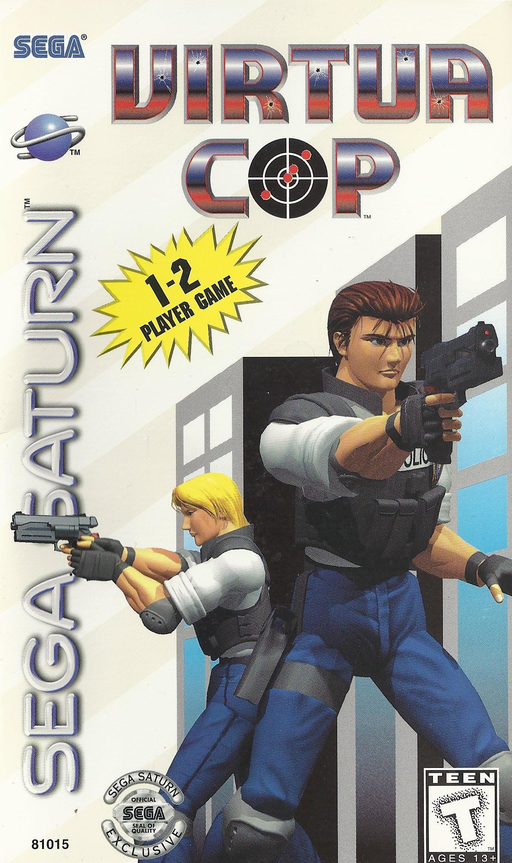
Sega AM2's 1994 arcade light-gun game ported to Saturn — Virtua Cop pioneered 3D polygonal graphics in the light-gun genre, replaced the sprite-based graphics of Operation Wolf and Area 51 with fully 3D environments and enemy models, introduced accuracy scoring and the distinction between hostage and criminal targets, and established the template for all subsequent 3D police-themed shooters.