🕹️
The Legend of Zelda: Ocarina of Time
1998
.png)
NINTENDO-64
10
Reviewed by Marcus Webb & Elena Castillo ·
Sega AM2's 1994 arcade light-gun game ported to Saturn — Virtua Cop pioneered 3D polygonal graphics in the light-gun genre, replaced the sprite-based graphics of Operation Wolf and Area 51 with fully 3D environments and enemy models, introduced accuracy scoring and the distinction between hostage and criminal targets, and established the template for all subsequent 3D police-themed shooters.
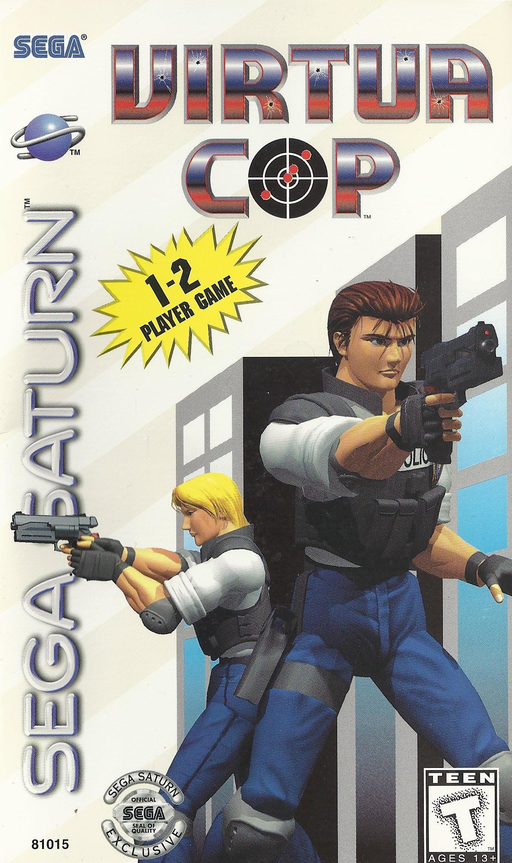
A parking lot. A harbor. A factory. Criminals with guns who emerge from cover and aim before firing.
Virtua Cop arrived in 1994 with a simple change to the light-gun genre that made all previous games look like flat cardboard: the enemies were polygons.
Operation Wolf had sprites. Area 51 had sprites. Every light-gun game before Virtua Cop was a photograph or painting — a flat image that represented a target.
Virtua Cop’s enemies were 3D models built from the same polygon technology that AM2 had used for Virtua Fighter. They weren’t photographs of actors displayed in sequence — they were geometry that rotated, animated, and moved through three-dimensional space as they approached, ducked, and aimed.
A criminal stepping out from behind a car was stepping in three-dimensional space. A guard raising a weapon was raising it from a 3D holster at a geometry angle. When they fell after being shot, they fell with physics rather than displaying a death sprite.
S, A, B, C, D, E. Six possible ratings per stage based on precision.
Virtua Cop’s grading distinguished it from light-gun games where quantity of shooting was the strategy. The optimal approach — the path to S rank — required firing only when certain of contact. A headshot counted more than a body hit. Missing counted against accuracy regardless of whether other shots connected.
The grading created a skill ceiling that multiple playthroughs couldn’t exhaust. Clearing all three stages was achievable on the first play. Achieving S rank on all three required understanding each enemy’s appearance timing and firing pattern well enough to eliminate them with minimum shots.
Virtua Cop’s Saturn port was one of the console’s argument for arcade fidelity. Sega’s arcade-to-Saturn promise — that the home system would deliver the arcade experience — was most visible in games like this: 3D polygon shooting that required the Virtua Gun peripheral to replicate.
The Virtua Gun bundled version was Saturn at its intended purpose. The game wasn’t a console experience compromised from an arcade vision — it was the arcade vision delivered home with its peripheral intact.
Virtua Cop is an arcade-style light-gun shooter played with the Virtua Gun peripheral (Saturn version) or standard controller. Three stages — parking lot, harbor, factory — populated with criminal enemies who emerge from cover, aim at the player, and must be eliminated before they fire. Hostage-taking mechanics require careful targeting: shooting a hostage costs points and reduces score grade. Accuracy rating from S to E tracks marksmanship across each stage. Two-player simultaneous co-op allows both players to fire simultaneously. Multiple enemy types require different timing — some enemies raise their weapons slowly, others draw quickly. The Saturn port adds content beyond the arcade original.
Virtua Cop's 3D polygon graphics were the light-gun genre's first departure from sprites. Enemy models are fully 3D, rotating and animating in three dimensions rather than flickering sprite replacements. The polygon aesthetic is the AM2 house style — the same engine that produced Virtua Fighter.
Virtua Cop's action-movie audio tracks enemy announcements, weapon firing, and stage ambience. The police radio communications during stages establish the scenario without interrupting gameplay momentum.
Three stages with accuracy grading from S to E, two-player co-op, score optimization through headshots and accuracy, and additional Saturn content beyond the arcade original provide fighting game-style replay through skill mastery.
Virtua Cop (1994 arcade; 1995 Saturn) was Sega AM2's follow-up to Virtua Fighter — applying the same Model 1 3D polygon hardware to the light-gun genre. It was the first light-gun game with fully 3D environments and enemy models rather than sprites. The accuracy grading system and hostage mechanics influenced subsequent light-gun games including Time Crisis's cover system. The Saturn version was bundled with the Virtua Gun peripheral and became one of the console's showcase titles demonstrating Saturn's arcade fidelity. Virtua Cop 2 (1996 Saturn) expanded the formula; together they defined the 32-bit light-gun era.
.png)
.png)
.png)