Super Star Wars: Return of the Jedi

Reviewed by Marcus Webb & Elena Castillo ·

JVC's 1994 SNES action-platformer and the conclusion of the Super Star Wars trilogy — Super Star Wars: Return of the Jedi expands the playable roster to four characters (Luke, Han, Leia, Wicket the Ewok), adapts Episode VI's Tatooine desert, Endor forest, and Death Star II locations with Mode 7 vehicle sequences for the speeder bike chase and Millennium Falcon run, and delivers the series' largest character variety.
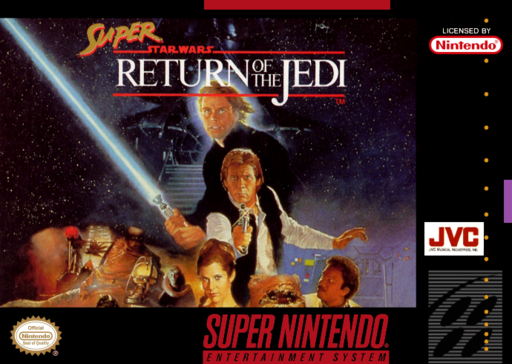
Super Star Wars: Return of the Jedi box art

💡 Super Star Wars: Return of the Jedi — Key Facts

  • Super Star Wars: Return of the Jedi was developed by Sculptured Software and published by JVC
  • Released in 1994 on SNES
  • Genre: Action, Platformer
  • We rate it 8.7/10 — highly recommended
  • JVC's 1994 SNES action-platformer and the conclusion of the Super Star Wars trilogy — Super Star Wars: Return of the Jedi expands the playable roster to four characters (Luke, Han, Leia, Wicket the Ewok), adapts Episode VI's Tatooine desert, Endor forest, and Death Star II locations with Mode 7 vehicle sequences for the speeder bike chase and Millennium Falcon run, and delivers the series' largest character variety.

Overview

Jabba’s Palace. Endor’s forest. The Death Star II’s reactor core. The Emperor on his throne.

Super Star Wars: Return of the Jedi closed the JVC trilogy in 1994 with four characters and the speeder bike sequence that players still cite as the series’ finest moment.

The Four Characters

Previous entries had limits. The original gave three characters but focused on Luke. Empire Strikes Back narrowed to Luke alone across the full campaign. Return of the Jedi expanded: four characters, each with actual stages designed for them.

Leia’s playable stages were notable in 1994. A female protagonist across multiple platform game sections wasn’t common in licensed games of the era. Her Endor stages played differently than Luke’s Force-heavy approach and Han’s gunslinger positioning.

Wicket is the genuine novelty. An Ewok as a playable character in an action platformer requires reimagining what the stage design looks like — the Endor forest stages built for Wicket’s sling and movement properties are unlike any stage in the previous two games. The series’ most unusual content is the Ewok gameplay.

The Speeder Bike

Mode 7 had been used across the trilogy. The landspeeder, the Millennium Falcon, the AT-AT approach. Each used the scaling technique for different effect.

The speeder bike chase is what Mode 7 can do when the sequence’s premise perfectly matches the technique’s strengths: speed, obstacle avoidance, forward momentum through a scaling environment. Endor’s forest canopy scales at the velocity that the chase in the film suggested — not quite the same as the film’s camera, but the closest SNES hardware could approximate to that sense of motion.

The sequence is short — the game can’t sustain it across a full stage. The brevity might be why it’s remembered so positively: the Mode 7 speeder bike is an experience concentrated into its optimal duration.

The Conclusion

Three games. Three films. The trilogy ends with Luke facing Palpatine and the Death Star’s destruction.

The JVC Star Wars trilogy is one of the licensed game series that exceeded expectations at every entry. Not because Star Wars guaranteed quality — it didn’t, the franchise’s gaming history is inconsistent — but because Sculptured Software and JVC understood what the SNES could do with the source material and did it at each opportunity.

Our Review

8.7
Excellent / 10
🎮
Gameplay
★★★★★
🎨
Graphics
★★★★★
🎵
Audio
★★★★★
🔄
Replay
★★★★★

Gameplay

Super Star Wars: Return of the Jedi adapts Episode VI with four playable characters for the first time in the trilogy. Luke (lightsaber, Force powers), Han Solo (blaster), Princess Leia (blaster, multiple stage appearances as protagonist), and Wicket the Ewok (sling, unique movement on Endor stages) each have distinct combat approaches. Eleven stages cover Jabba's Palace, the Sarlacc Pit, Endor forest, the speeder bike chase (Mode 7), the Death Star II, and the final Emperor confrontation. Luke's Force abilities from Empire Strikes Back continue with full powers from the start. The Ewok village stages and Endor sequences are the game's most distinct visual environments.

Graphics

Return of the Jedi's SNES visuals cover the film's most varied environments — Tatooine's desert palace, Endor's forest moon, the Death Star II's interior — with the JVC trilogy's characteristic detailed sprite work. The speeder bike Mode 7 sequence is one of SNES's most impressive showcase moments.

Audio

The Return of the Jedi score — including the Ewok celebration theme, Emperor's throne room music, and speeder bike chase compositions — appears in SNES adaptations closing the trilogy's audio arc with appropriate thematic completeness.

Replayability

Four playable characters with distinct movesets, eleven stages including Ewok-exclusive content, Mode 7 speeder bike and Millennium Falcon sequences, and the series finale narrative provide trilogy-completion replay for Super Star Wars players.

Historical Significance

Super Star Wars: Return of the Jedi (1994) completes JVC and Sculptured Software's three-game SNES Star Wars trilogy. The addition of Leia and Wicket as playable characters expanded character variety beyond the previous games' more limited rosters. The speeder bike Mode 7 sequence is frequently cited as one of SNES's most impressive Mode 7 implementations. The trilogy — Super Star Wars, Empire Strikes Back, Return of the Jedi — is collectively considered among the finest licensed game series of the 16-bit era, with ESB generally rated highest, ROTJ second, and the original third.

Pros

  • + Four playable characters — largest roster of the JVC trilogy
  • + Speeder bike Mode 7 — arguably series' finest vehicle sequence
  • + Princess Leia as lead character in multiple stages
  • + Ewok village stages provide unique Endor gameplay
  • + Eleven stages providing the trilogy's longest campaign

Cons

  • - Wicket's sling less satisfying than Luke's lightsaber or Han's blaster
  • - Jabba's Palace stages can feel repetitive
  • - Generally rated below Empire Strikes Back in quality
  • - Luke overpowered with full Force abilities from start

Also Known As

Super Return of the Jedi SNESSuper Star Wars ROTJスーパースターウォーズ ジェダイの帰還

Super Star Wars: Return of the Jedi FAQ

Who are the four playable characters in Return of the Jedi?
Super Star Wars: Return of the Jedi features four playable characters — the most in the JVC SNES trilogy. Luke Skywalker returns with his full Force powers from Empire Strikes Back active from the start, with lightsaber melee and all Force abilities. Han Solo uses his blaster for ranged combat as in the previous entries. Princess Leia appears as a fully playable character across multiple Endor and Jabba's Palace stages — her blaster is similar to Han's but her stages are designed around her specific character role in the film. Wicket the Ewok is unique to ROTJ: he uses a sling for ranged attacks and has different movement physics suited to Endor's forest environment. The Wicket stages are the trilogy's most distinct content — gameplay designed around an Ewok character rather than adapting existing humanoid platformer mechanics. Leia's playable appearance was notable as female protagonist representation in 1994 SNES licensed games.
What is the speeder bike sequence and why is it significant?
The speeder bike sequence in Super Star Wars: Return of the Jedi adapts the Endor forest chase from Episode VI using Mode 7 scaling. Players on a speeder bike navigate through Endor's forest canopy at high speed, avoiding trees that scroll and scale using Mode 7's perspective transformation. The sequence is a top-down/behind view racing game within the platformer — players steer left and right to avoid obstacles while shooting pursuing Scout Trooper speeders. The Endor speeder bike chase is considered one of the most successful Mode 7 implementations in any SNES game — the sense of speed, the scaling forest environment, and the combat-while-racing challenge create an experience that the previous games' Mode 7 sequences didn't quite match. Many players who remember the JVC Star Wars trilogy specifically cite the speeder bike sequence as the memorable highlight of all three games.
How does Return of the Jedi compare to Empire Strikes Back in quality?
Super Star Wars: Return of the Jedi is generally regarded as the second-best of the JVC SNES trilogy behind Empire Strikes Back. ROTJ's advantages: four playable characters (vs. ESB's Luke-only focus), Wicket stages as unique content, the speeder bike Mode 7 sequence as technical highlight, and eleven stages providing the longest campaign. ESB's advantages: the Force upgrade progression system (Luke starts with all powers in ROTJ, removing that arc), the Hoth AT-AT sequences as a narrative-matched spectacle, and the Vader lightsaber duel as the trilogy's finest boss encounter. The source film quality also influences the comparison: Empire Strikes Back is broadly considered the superior film, providing more dramatic material. ROTJ's Jabba's Palace sections are considered the trilogy's weakest stage design; ESB maintained quality more consistently. Most players who've completed all three rank ESB first, ROTJ second, the original third.
Is Super Return of the Jedi available on modern platforms?
Super Star Wars: Return of the Jedi is available on Nintendo Switch Online's SNES library for Nintendo Switch Online subscribers, alongside Super Star Wars and Super Empire Strikes Back. The complete JVC SNES Star Wars trilogy is accessible through Switch Online. The game previously appeared on PS4 and PS Vita digitally. Physical SNES cartridges are available in retro game markets. Disney (Lucasfilm owner) has maintained digital availability of the trilogy as part of the Star Wars IP's gaming legacy. The three Super Star Wars games on Nintendo Switch Online allow completing the full JVC trilogy experience in sequence from Episode IV through VI.

Related Games

Games Like This →