Team Ninja's 3D fighting game with a counter-system that rewards defensive timing and multi-level stage environments where fighters can be knocked across floors and through breakable structures. Dead or Alive 2 on Dreamcast delivered the arcade experience with the series' defining gameplay mechanics and exceptional 3D presentation.
Games Like Virtua Fighter 3tb
12 games similar to Virtua Fighter 3tb — handpicked for fans of Fighting games.
Top Games Similar to Virtua Fighter 3tb
| Feature | Platform | Year | Score | Genre |
|---|---|---|---|---|
| Dead or Alive 2 | DREAMCAST | 2000 | 8.8 | Fighting |
| Marvel vs. Capcom 2 | DREAMCAST | 2000 | 9.2 | Fighting |
| Power Stone 2 | DREAMCAST | 2000 | 9.1 | Fighting, Action |
| Power Stone | DREAMCAST | 1999 | 8.5 | Fighting, Action |
| Soulcalibur | DREAMCAST | 1999 | 9.3 | Fighting |
| Street Fighter III: 3rd Strike | DREAMCAST | 2000 | 9.7 | Fighting |
All 12 Games Like Virtua Fighter 3tb
The crossover fighting game with 56 characters — drawn from across Marvel's comic universe and Capcom's entire fighting game history — three-on-three team mechanics, and the DHC combo system that defined competitive tag fighting games for a generation. Marvel vs. Capcom 2's Dreamcast version remains the definitive home release of one of the most technically demanding and strategically rich fighting games ever produced, a game whose competitive scene remained active for over two decades after its release.
Capcom's expansion of the Power Stone arena fighting concept to four-player chaos — Power Stone 2 adds larger multi-tier stages, stage-specific interactive hazards, a weapon crafting system, and four-player simultaneous combat that made it the definitive party fighting game on Dreamcast.
Capcom's arena fighter built around collecting three Power Stones to trigger dramatic mid-fight character transformations — shifting the entire power dynamic in seconds — across dynamic 3D arenas with destructible environments and item-based combat that were meaningfully ahead of their time. Power Stone's accessible controls masked genuine mechanical depth, and its design philosophy of environmental interaction as a combat resource would take the broader fighting game genre another decade to fully absorb.
The weapon-based fighting game that arrived with the Dreamcast and immediately became its defining showcase title. Soulcalibur's 8-way run movement system, fluid attack animations, and twelve distinctive weapon-fighters created a competitive depth that no fighting game had matched on home hardware. It held a perfect 10/10 at launch on multiple publications.
The most technically sophisticated Street Fighter game ever made and the pinnacle of Capcom's 2D fighting design. Street Fighter III: 3rd Strike on Dreamcast delivered the CPS3 arcade experience with the parry system that redefined fighting game defensive options, Ken and Ryu alongside an almost entirely new roster, and gameplay that competitive players are still mastering 25 years later.
SNK's 1994 Neo Geo sequel and the definitive Art of Fighting experience — Art of Fighting 2 dramatically expands the roster to 12 characters (from 2+2 boss-only in AOF1), adds Robert Garcia, Yuri Sakazaki, and King as fully playable alongside refined special move systems, improves the Spirit Gauge balance, and develops the franchise's story connecting to Fatal Fury's timeline.
The Neo-Geo fighter that introduced the spirit gauge, zoom camera, and desperation moves to the genre. Art of Fighting's distinctive power-dependent gameplay created a different strategic rhythm from Street Fighter II, and its characters would later cross over into King of Fighters.
Light Weight and Square's 1997 PS1 sword-fighting game that rejected health bars entirely — Bushido Blade uses a realistic limb damage system where strikes to the body can kill or disable in one hit. A unique, contemplative fighting game about the geometry of sword combat rather than combo execution, set in feudal Japanese environments with freedom of movement.
Capcom's 1995 PS1 fighting game — Darkstalkers: The Night Warriors presents a roster of supernatural creatures (Morrigan the succubus, Felicia the catgirl, Jon Talbain the werewolf, Demitri the vampire) with fluid animation and specialized special moves. The franchise that pioneered fighting game animation quality and gave Capcom its darkest 2D fighter.
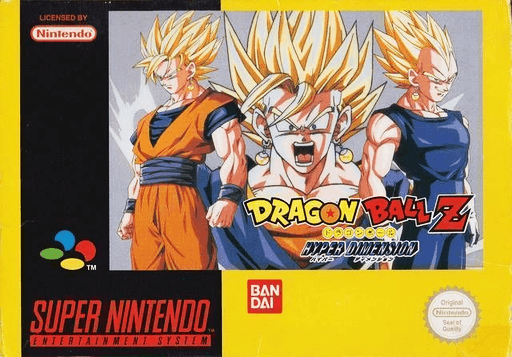
Bandai's 1996 SNES one-on-one fighting game and the final DBZ game on Super Nintendo — Dragon Ball Z: Hyper Dimension features large character sprites pushing SNES hardware limits, aerial combat with characters that can fly across the stage, ki charging system for super attacks, Story Mode following the Cell and Buu sagas, and is considered the finest 2D Dragon Ball Z fighting game of its era.
Bandai and TOSE's 1993 SNES fighting game based on the Dragon Ball Z Android and Cell arcs — Dragon Ball Z: Super Butōden 2 features 13 playable characters including Future Trunks, Android 18, Android 17, Piccolo, and Cell, with the series' signature energy-based combat and Super Saiyan transformations.