🕹️
The Legend of Zelda: Ocarina of Time
1998
.png)
NINTENDO-64
10
Reviewed by Marcus Webb & Elena Castillo ·
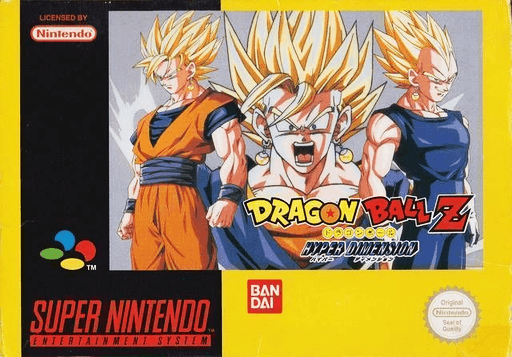
Bandai's 1996 SNES one-on-one fighting game and the final DBZ game on Super Nintendo — Dragon Ball Z: Hyper Dimension features large character sprites pushing SNES hardware limits, aerial combat with characters that can fly across the stage, ki charging system for super attacks, Story Mode following the Cell and Buu sagas, and is considered the finest 2D Dragon Ball Z fighting game of its era.
A ki gauge fills. The Kamehameha charges. The energy beam fills the screen.
Dragon Ball Z: Hyper Dimension arrived in 1996 as the SNES’s final major Dragon Ball statement — large sprites, aerial combat, and the ki-charging structure that the franchise’s fighting game legacy would build on.
SNES fighting games competed on character sprite size as a proxy for visual ambition. Hyper Dimension’s sprites were among the largest on the platform — character models approaching the scale of what SNK’s Neo Geo produced with dedicated hardware. The trade-off: the SNES couldn’t sustain the animation density that Neo Geo managed at similar sprite sizes.
The visual scale was appropriate to the source material. Dragon Ball Z’s fight sequences operate at planetary destruction level — combatants who can destroy continents with misaimed attacks. A fighting game representing this required sprites large enough to read as the characters rather than representative icons.
The Super Saiyan transformation changed the sprite’s aura and color palette visually. Super Saiyan Goku and base Goku are separate roster entries rather than mid-fight transformations, which is a design limitation — the anime’s transformations occur during fights as power escalation moments. The roster solution acknowledges the constraint while providing both versions as playable options.
The ki gauge fills. Filling it requires combat activity — hits landed, attacks blocked, pressure sustained.
The charging system creates pacing decisions that pure technical execution fighting games don’t have. A player who charges manually becomes temporarily vulnerable; a player who waits for the gauge to fill from combat activity cedes ground to build the resource. The Super Attack’s power — screen-filling Kamehameha beams, Final Flash’s charged energy burst — is proportional to how much resource management it cost to create.
Club Dorothée brought Dragon Ball to French children in 1988. The anime was a formative cultural object for a generation before it reached most Western markets.
Hyper Dimension reached France. It didn’t reach North America. The European release created a geographic split in DBZ gaming experience: French players had a SNES fighting game that matched their enthusiasm for the franchise; North American DBZ fans had no equivalent home console option.
The French SNES generation’s relationship with Hyper Dimension is cultural history as much as gaming history — a game that became a touchstone for a community that received it, while remaining inaccessible to an equal community that didn’t.
Dragon Ball Z: Hyper Dimension is a one-on-one fighting game featuring 10 DBZ characters: Goku, Super Saiyan Goku, Gohan, Super Saiyan Gohan, Vegeta, Trunks, Piccolo, Cell, Frieza, and Majin Buu. Characters can fly across the screen — movement is both horizontal ground and aerial. Ki charges from a gauge that fills through attacking and blocking; Super Attacks including Kamehameha, Final Flash, and Special Beam Cannon consume ki and deal massive damage. Story Mode follows two arcs: the Cell Saga and the Buu Saga. The two-player versus mode provides competitive fighting. The SNES Mode 7 creates the scrolling background impression during particularly large ki attacks.
Dragon Ball Z: Hyper Dimension's sprites are among the largest and most detailed on SNES — character models at a scale that approximated the anime's visual scale. Super Saiyan transformations are visually distinct with aura effects. The game represented a late-SNES technical showcase for sprite work.
DBZ Hyper Dimension's soundtrack draws from the Dragon Ball Z anime score — battle compositions and character theme adaptations appropriate to the franchise's epic combat tone.
Two story arcs (Cell and Buu sagas), 10 characters with distinct ki attack sets and aerial combat options, two-player versus, and Super Saiyan transformation mastery provide fighting game replay.
Dragon Ball Z: Hyper Dimension (1996 SNES) is the last major Dragon Ball Z game on SNES and is widely considered the best 2D Dragon Ball Z fighting game of the 16-bit era. Released in Japan and Europe (particularly France, where DBZ had an enormous fanbase through Club Dorothée) but not in North America, the game was influential in European DBZ gaming culture. The game's large sprites and ki mechanic influenced subsequent DBZ fighting games including the Budokai series. In France specifically, Hyper Dimension has a cultural status equivalent to the most beloved fighting games of the SNES era.
.png)
.png)
.png)