🕹️
The Legend of Zelda: Ocarina of Time
1998
.png)
NINTENDO-64
10
Reviewed by Marcus Webb & Elena Castillo ·
Sega AM2's 1993 arcade revolutionary and its celebrated Saturn port — the original Virtua Fighter introduced polygonal 3D fighting to the world, establishing eight martial artists (Akira, Sarah, Jacky, Pai, Lau, Kage, Wolf, Jeffry) in three-button combat that abandoned the fireball projectile conventions of Street Fighter and instead rewarded understanding of real martial arts mechanics, spacing, and frame-perfect execution.
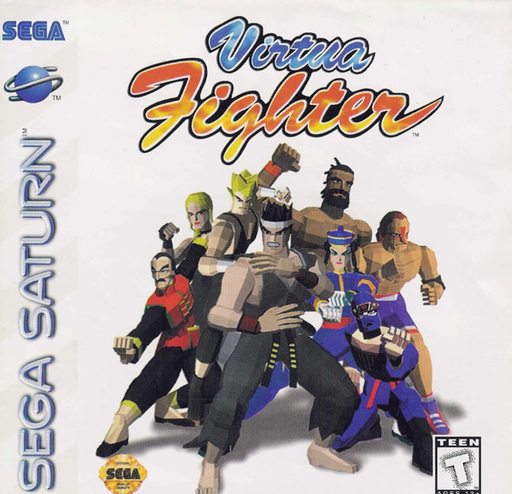
Flat polygons. Eight fighters. No fireballs.
Virtua Fighter arrived in arcades in 1993 and made every other fighting game look like a different genre. Not because it was better — Street Fighter II and Mortal Kombat were excellent games — but because it was playing a different game entirely.
The fighting game vocabulary in 1993 was defined by Capcom: quarter-circle inputs, special moves with specific animation frames, projectiles that created a spatial game around their startup and recovery. Virtua Fighter had none of this.
Three buttons: Punch, Kick, Guard. Eight characters each with techniques derived from actual martial arts disciplines. Bajiquan for Akira. Jeet Kune Do for Sarah. Professional wrestling for Wolf. The techniques weren’t stylized game-attacks — they were documented martial arts techniques with game-appropriate timing and range.
The effect was that learning Virtua Fighter felt like learning something rather than memorizing inputs. Understanding when Akira’s double palm technique was safe on block required knowing how his body moved, not which buttons to press.
The ring-out condition was the 3D space made explicit. Push an opponent over the edge and the round ended — not from health depletion but from spatial control. Suddenly fighting games had a center and a perimeter, a resource to defend and a threat to apply through positioning alone.
The ring didn’t just add dimension. It changed what fighting meant. Defense wasn’t just blocking — it was maintaining ground. Offense wasn’t just dealing damage — it was territory control.
The Saturn launched in Japan in November 1994 with Virtua Fighter as its primary software. The game sold consoles. People bought the Saturn to play Virtua Fighter at home, to learn Akira’s precise technique timing in their own room rather than feeding quarters into an arcade cabinet.
Virtua Fighter 2 arrived in 1995 and superseded it visually and mechanically. But the original created the genre, the character, and the reason the Saturn existed.
Virtua Fighter is a one-on-one 3D fighting game using Punch, Kick, and Guard — three buttons producing a complete fighting game vocabulary without the quarter-circle special moves that defined the Street Fighter era. Eight fighters each embody distinct martial arts disciplines: Akira's Bajiquan close-range power, Sarah's Jeet Kune Do blend, Jacky's boxing-based offense, Pai's Mizongyi counter-focus, Lau's Tan Tui fast strikes, Kage's ninjutsu ground combat, Wolf's professional wrestling grapples, and Jeffry's rough power-grappling. Combat is determined by spacing, timing, throw/strike mixups, and character-specific move understanding rather than special move execution. The Saturn port was the console launch title and included the Kumite mode for extended single-player play.
The original Virtua Fighter's polygonal graphics were revolutionary in 1993-1994 and show their age now — flat-shaded polygon characters with no textures represent the genre's 3D starting point. The Saturn version's visual quality was superseded by Virtua Fighter 2 within a year but remains historically significant as the first fully 3D fighting game.
Virtua Fighter's audio design emphasized impact over musicality — the sound of strikes connecting, throws landing, and ring-outs was calibrated for physical weight. The stage themes were atmospheric rather than melodic, appropriate to a game prioritizing martial arts authenticity over spectacle.
Eight characters each with mechanically distinct fighting systems create replay through mastery of different disciplines. The Kumite mode's CPU progression, the two-player competition, and the execution demands of advanced Akira techniques provide long-term engagement for dedicated fighting game players.
Virtua Fighter (1993 arcade; 1994 Saturn) is the most historically significant fighting game ever made. The game introduced polygonal 3D fighting to the world, establishing every convention that three-dimensional fighting games would use for decades: circular movement (absent here but implied by the 3D space), ring-out victory conditions, the replacement of projectile specials with real martial arts techniques, and the three-button control scheme that Sega refined across subsequent entries. The Saturn version was the console's launch title in Japan and drove Sega Saturn hardware sales in ways that no other game could match — it was the reason to own a Saturn in 1994. Virtua Fighter 2 (1995) improved the formula substantially, but the original Virtua Fighter created the 3D fighting game genre. Its eight characters, three-button design, and martial arts authenticity philosophy established the template that Tekken, Dead or Alive, and SoulCalibur each built on.
.png)
.png)
.png)