Teenage Mutant Ninja Turtles III: The Manhattan Project

Reviewed by Marcus Webb & Elena Castillo ·

Konami's 1992 NES beat-em-up and the second side-scrolling TMNT NES game — Teenage Mutant Ninja Turtles III: The Manhattan Project improves on TMNT II: The Arcade Game with Super Jump moves unique to each turtle, a longer eight-stage campaign with Manhattan transported to Florida by Shredder's flying island, and a larger budget presentation that made it one of the NES's finest late-era beat-em-ups.
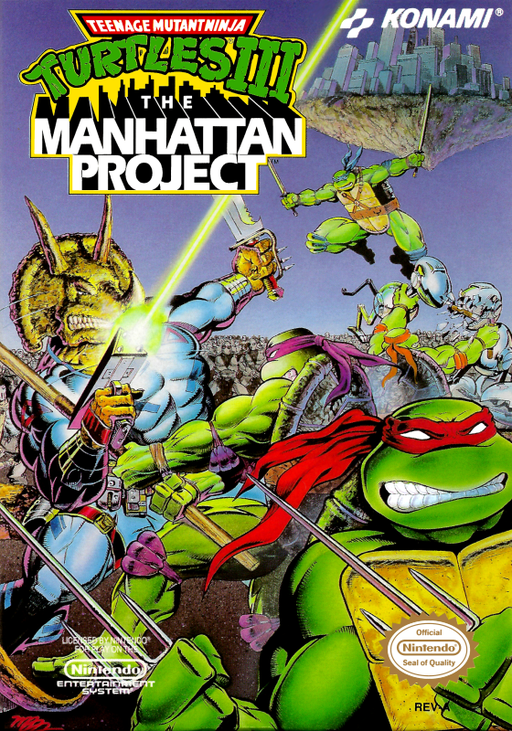
Teenage Mutant Ninja Turtles III: The Manhattan Project box art

💡 Teenage Mutant Ninja Turtles III: The Manhattan Project — Key Facts

  • Teenage Mutant Ninja Turtles III: The Manhattan Project was developed by Konami and published by Konami
  • Released in 1992 on NES
  • Genre: Action, Beat 'em Up
  • We rate it 8.5/10 — highly recommended
  • Konami's 1992 NES beat-em-up and the second side-scrolling TMNT NES game — Teenage Mutant Ninja Turtles III: The Manhattan Project improves on TMNT II: The Arcade Game with Super Jump moves unique to each turtle, a longer eight-stage campaign with Manhattan transported to Florida by Shredder's flying island, and a larger budget presentation that made it one of the NES's finest late-era beat-em-ups.

Overview

Shredder lifted Manhattan. The entire island, elevated above the city on a flying platform, with April O’Neil captive and the four turtles on vacation in Florida when it happened.

The premise required a game. Konami provided one.

The Third NES TMNT

Three Konami TMNT games on NES, each a different approach. The original TMNT (1989) was an action platformer — overhead and side-scrolling sections, Foot Clan infiltration, difficult. TMNT II: The Arcade Game (1990) was the two-player co-op beat-em-up based on the coin-op. Manhattan Project (1992) was the original design not borrowed from an arcade source.

No arcade version meant no arcade constraints. Konami could design eight stages for NES rather than adapting six stages from coin-op. The Super Jump moves — aerial specials unique to each turtle — weren’t in TMNT II because the arcade game didn’t have them. Manhattan Project added them because the designers wanted them and weren’t bound by an existing product.

The Super Jumps

Each turtle has a jump. The ground attacks are variations of range and speed. The aerial specials are where the four characters diverge into genuinely different play styles.

Leonardo’s aerial sword drop is precise — a forward arc that hits ahead of the landing point. Donatello’s bo spin is horizontal, hitting everything at arm’s length from center. Michelangelo’s nunchuck whirl creates a circular sweep around him. Raphael’s downward sai drives into enemies directly below.

The same enemy configuration approaches differently depending on which turtle jumps into it. The aerial mechanic turns character selection into tactical decision rather than aesthetic preference.

The Late Era

  1. The SNES had launched. The NES’s commercial moment was passing.

Konami knew the hardware completely by this point — years of NES development had pushed the limits of what the 8-bit hardware could produce. Manhattan Project’s graphical quality is among the NES’s late-era best: sprites clear and distinct, stage backgrounds varied and readable, the visual presentation polished in ways that 1985-era NES games couldn’t achieve.

The game is a demonstration of what expertise with aging hardware produces: not new capabilities, but complete expression of existing ones.

Our Review

8.5
Excellent / 10
🎮
Gameplay
★★★★★
🎨
Graphics
★★★★★
🎵
Audio
★★★★★
🔄
Replay
★★★★★

Gameplay

TMNT III: The Manhattan Project is a side-scrolling beat-em-up for one or two simultaneous players. All four turtles playable: Leonardo (sword slash combo), Michelangelo (nunchuck spin), Donatello (bo staff range), Raphael (short sai range, highest individual damage). Each turtle has a unique Super Jump attack — aerial special performed by jumping and pressing attack — that distinguishes their combat style beyond weapon range. Eight stages progressing from Florida beach through Manhattan streets to Shredder's flying island. Two-player simultaneous co-op with friendly fire disabled. April O'Neil must be rescued from Shredder who has placed Manhattan on a levitating island.

Graphics

TMNT III's NES visuals are among the best beat-em-up graphics on the platform — detailed character sprites, varied enemy designs including classic TMNT villains (Bebop, Rocksteady, Baxter Stockman, Krang, Shredder), and stage backgrounds that convey each setting clearly.

Audio

TMNT III's soundtrack by Konami's in-house composers provides stage-appropriate action music with the energetic compositions characteristic of Konami's NES output. The music distinguishes stages and boss encounters effectively.

Replayability

Eight stages with two-player co-op, four turtle character selection with different combat styles, Super Jump mastery, and the beat-em-up structure of pattern learning across the villain roster provide solid genre replay.

Historical Significance

TMNT III: The Manhattan Project (1992) is Konami's third NES TMNT game and the second side-scroller (after TMNT II: The Arcade Game). It was one of the NES's late-era showcases — released in 1992 when the SNES had already launched, demonstrating how much developers had learned to push the aging hardware. The Super Jump moves added turtle-specific aerial attacks absent from TMNT II. The game was NES-exclusive — unlike TMNT II which was a port of the Konami arcade game, Manhattan Project was designed as an original NES title. Combined with TMNT NES (action platformer) and TMNT II (arcade port), it completes the trio of Konami TMNT NES experiences.

Pros

  • + Unique Super Jump attacks for each turtle beyond weapon differences
  • + Eight stages — longest Konami TMNT NES game
  • + All four turtles with meaningful combat style distinctions
  • + Two-player simultaneous co-op without friendly fire
  • + Late NES-era visual polish — platform hardware maximized

Cons

  • - Difficult final stages with Shredder as a two-phase boss
  • - NES hardware limitations vs. SNES-era contemporaries
  • - Bebop/Rocksteady appearances can feel repetitive as mid-bosses
  • - Original NES TMNT's platformer structure preferred by some

Also Known As

TMNT Manhattan ProjectTMNT 3 NESTeenage Mutant Ninja Turtles 3 NESTMNT III

Teenage Mutant Ninja Turtles III: The Manhattan Project FAQ

How do the four turtle characters differ in Manhattan Project?
TMNT III: The Manhattan Project's four characters have distinct weapon ranges and unique Super Jump moves. Leonardo uses swords — balanced range, reliable chain attacks, and a Super Jump that brings both swords down in an arc in front of him. Donatello uses the bo staff — the longest weapon range in the game, allowing hits from farther distance than other turtles, with a Super Jump that spins the staff horizontally. Michelangelo uses nunchucks — mid-range with a circular spinning attack useful for hitting enemies on both sides, Super Jump creates a spinning whirl. Raphael uses sai — the shortest range weapon but highest individual hit damage, Super Jump drives sai downward into whatever he lands on. The range differences create genuine character preference: Donatello's bo range suits players who want to engage safely from distance; Raphael rewards players who can get in close and maximize his damage output.
What is the plot of The Manhattan Project?
The Shredder and Krang have placed Manhattan Island on a flying island using Krang's technology, lifting the entire borough of New York into the sky. This follows the pattern of TMNT villain schemes for dramatic geographic threat rather than conventional criminal activity. April O'Neil has been captured. The Turtles are in Florida when the scheme activates — their vacation interrupted by Shredder's announcement that he's levitated their home city. The eight-stage progression takes the Turtles from the Florida beach where they were vacationing through cities, underground areas, and ultimately to Technodrome and a confrontation with Shredder on the floating island. The narrative justifies the stage variety by placing Manhattan in an unusual context and requiring the Turtles to fight through multiple environments to reach it.
How does Manhattan Project compare to TMNT II: The Arcade Game?
TMNT III: The Manhattan Project is the original NES beat-em-up sequel to TMNT II: The Arcade Game (1990). TMNT II was a port of Konami's 1989 arcade game — a six-stage game based on the arcade source material, limited by what the arcade original contained. Manhattan Project is an original NES title not based on an existing arcade game, allowing Konami to design specifically for the NES without arcade constraints. Manhattan Project is longer — eight stages versus TMNT II's six — and adds the Super Jump moves unique to each turtle that TMNT II lacked. The enemy variety is expanded, including more Foot Clan sub-bosses and greater villain roster variety. Many players consider Manhattan Project the superior game: more content, more mechanical depth, and demonstrating more understanding of what made the TMNT beat-em-up format work. TMNT II's arcade-port origin gives it historical status; Manhattan Project is the better-designed game.
Is TMNT III: The Manhattan Project available on modern platforms?
TMNT III: The Manhattan Project is available on Nintendo Switch Online's NES library for Nintendo Switch Online subscribers. The game was one of the NES titles included in the Switch Online service. The game has also been available on Wii Virtual Console and appeared on various digital retro platforms historically. Physical NES cartridges are available in retro game markets. The Cowabunga Collection (Konami, 2022) compiled 13 TMNT games including TMNT III: The Manhattan Project on modern platforms (PS4/PS5/Switch/Xbox/PC), providing the most accessible current route to play the game. The Cowabunga Collection also includes the NES TMNT and TMNT II alongside Manhattan Project, allowing the complete NES TMNT series to be played on contemporary hardware.

Related Games

Games Like This →