🕹️
The Legend of Zelda: Ocarina of Time
1998
.png)
NINTENDO-64
10
Reviewed by Marcus Webb & Elena Castillo ·
Acquire's 1998 PS1 stealth-action game and the originator of the PlayStation stealth genre — Tenchu: Stealth Assassins places players as feudal Japan ninja Rikimaru or Ayame completing assassination missions through populated environments using shadow movement, tool usage, and the grappling hook, establishing the stealth assassination mechanic that Metal Gear Solid's success that same year confirmed was a genre with mass appeal.
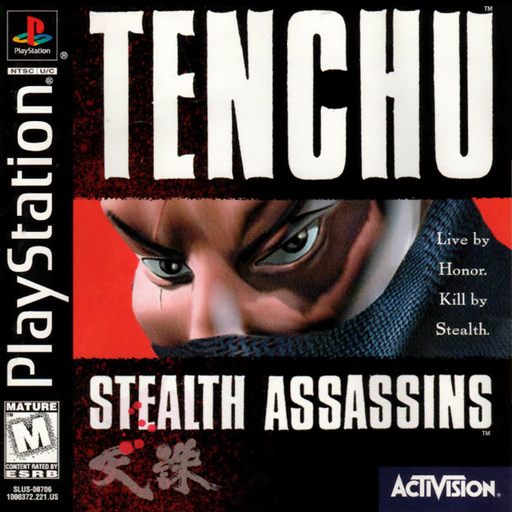
A feudal Japan village at night. Guards on patrol routes. A grappling hook that reaches the roof.
Tenchu: Stealth Assassins gave ninja stealth its first serious 3D implementation in 1998, arriving the same year as Metal Gear Solid to simultaneously define what stealth games could be.
Green. Yellow. Red.
Three states, one enemy awareness indicator that made guards into something games hadn’t quite managed before: obstacles with limited perception rather than security cameras with perfect angles.
The green-to-yellow transition happened through sound and sight lines. A guard who heard footsteps went yellow — suspicious, investigating, not yet committed to combat. A player who moved when a guard looked away remained green. The state model made the environment a system to understand rather than a static backdrop to navigate.
The stealth kill required green state — approaching from behind an unaware guard and pressing attack produced the execution animation. The setup created the game’s core satisfaction: learning a guard’s pattern, positioning in their blind spot, closing the distance during a look-away, executing.
The grappling hook changed what feudal Japan environments meant.
A wooden building’s roof became a navigation option — not decorative background, but tactically accessible elevated ground. Dropping from a roof onto a guard below produced a stealth kill from above. Moving across rooftops while guards patrolled below was a completely different approach to any mission than ground-level movement.
The three-dimensional space — vertical as well as horizontal — was what separated Tenchu from side-scrolling ninja predecessors. The environment was a problem to solve using all dimensions available.
Metal Gear Solid received more attention in 1998. Konami’s marketing, Hideo Kojima’s name, the franchise’s legacy from MSX and NES.
Tenchu received credit from the players and historians who traced where 3D stealth sandbox design came from. The KI system, the environment-as-problem-space, the rating system that rewarded optimal stealth — these were Tenchu’s contributions that Metal Gear Solid’s narrative-focused linear approach didn’t include.
The two games weren’t competing. They were defining two different interpretations of what stealth could mean in 3D — Metal Gear Solid’s cinematic espionage, Tenchu’s sandbox assassination.
Tenchu: Stealth Assassins is a third-person action game where ninja Rikimaru (balanced) or Ayame (fast, dual swords) complete 10 missions in feudal Japan — each mission has a primary target and optional additional kills for higher rank. The KI meter displays enemy awareness: green (unaware), yellow (suspicious), red (combat). Eliminating enemies undetected provides Stealth Kill bonus animations — unique kills from behind, above, or below that are more visceral than combat. The grappling hook allows vertical movement onto rooftops and over walls. Items include shuriken, smoke bombs, caltrops, and poison rice for non-combat enemy handling. Mission rating from Grand Master to Thug based on kills, stealth, and time.
Tenchu's PS1 3D environments — feudal Japanese villages, castles, temples, bamboo forests — convey the ninja fantasy through functional rather than detailed geometry. Character models serve the stealth game's gameplay requirements over visual detail.
Tenchu's sound design is the game's primary tension tool — guard footsteps, ambient environment noise, and the transition from peaceful to combat music when detection occurs create the stealth experience. Japanese flute and percussion compositions establish period atmosphere.
Mission rating system from Grand Master to Thug incentivizes replaying with increasing stealth and efficiency, Ayame as a speed-focused alternate playthrough, and 10 missions with multiple approach routes create significant replay depth.
Tenchu: Stealth Assassins (1998) arrived the same year as Metal Gear Solid and defined the stealth game as a 3D genre simultaneously from two different studios. Tenchu pioneered the 3D stealth assassination sandbox — giving players an environment with patrolling guards, tools for different approach styles, and rating systems that rewarded stealth over combat. The ninja setting established the visual language of the stealth game genre. Tenchu's development by Acquire gave the smaller studio historical credit for originating the genre's open-sandbox approach while Konami's Metal Gear Solid received more commercial attention. The franchise continued through multiple sequels.
.png)
.png)
.png)