🕹️
The Legend of Zelda: Ocarina of Time
1998
.png)
NINTENDO-64
10
Reviewed by Marcus Webb & Elena Castillo ·
Inti Creates' 2005 GBA action-platformer and the final chapter of Zero's story — Mega Man Zero 4 concludes Zero's four-game narrative arc with Dr. Weil's satellite cannon threatening Area Zero, introduces the EX Skill weather system where environmental conditions affect which abilities are available, and delivers a bittersweet ending that resolved the Zero series' long-running human-Reploid conflict.
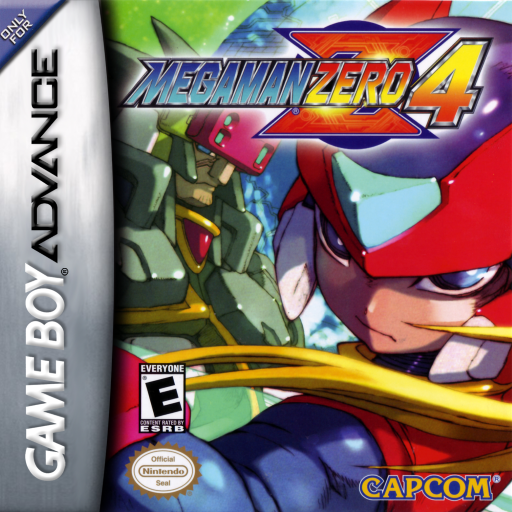
The satellite falls. Below, Area Zero — the last human settlement, the forest where Reploids and humans coexisted after the Elf Wars.
Mega Man Zero 4 ends where Zero’s story ends.
Each stage has weather. Weather determines what variant of the EX Skill Zero receives from defeating the stage boss — the same boss in hot weather yields a different power than the same boss in cold weather.
The system creates a replay structure that previous Zero games built through different means. In Zero 3, the Cyber Elf fusion system incentivized careful boss encounters. In Zero 4, the weather variable incentivizes returning to completed stages under different conditions to collect the alternate skill versions.
The village hub’s weather influence mechanic — Factory components allowing some weather control before missions — gives players partial agency over the variables rather than pure RNG. Understanding which weather combination to target requires knowing what each boss yields and under what conditions.
Dr. Weil’s satellite. A weapon aimed at Area Zero.
The final stages ascend from the forest’s safety toward the satellite’s interior — the game’s visual and musical peak. Inti Creates’ composers built toward the Ragnarok confrontation across the game’s arc; the final stages’ music treats the ascent as the climax it is.
The design history makes the Ragnarok confrontation specific: Zero’s four-game arc began with his awakening in a ruined world where the Elf Wars had reshaped civilization. Weil was the Elf Wars’ architect. The final confrontation closes the circle that the first game opened.
Mega Man Zero’s story ends here. Not the franchise’s end — Mega Man ZX continued in a different era, Mega Man ZX Advent further still. But Zero’s story, specifically, ends at the Ragnarok sequence’s conclusion.
The Mega Man X series that Zero appeared in — as a recurring character across eight games — never gave him a final chapter. Zero 4 did. For players who’d followed the Zero series from awakening to conclusion, the ending provided what the broader franchise had never managed: closure for the character who’d been a fan favorite since his 1994 introduction in X.
Mega Man Zero 4 is the fourth and final entry in the Zero series. Zero continues with the Z-Saber, Z-Buster, and Chain Rod (from Zero 3 as standard) plus the new Chain Rod techniques. The primary new system: weather conditions in each stage alter environmental hazards and enemy behavior, and the player can influence weather using Factory parts collected in the village hub. Defeating bosses awards EX Skills modified by active weather — cold weather creates different versions of abilities than hot weather. Eight Einherjar Robot Masters include Weather-themed bosses like Soleil Mirabilis and Fenri Lunaedge. The story culminates in the assault on Dr. Weil's Ragnarok satellite and the final confrontation.
Mega Man Zero 4's GBA visuals represent Inti Creates' peak sprite work for the platform — detailed character and enemy animations, expressive boss designs, and environmental variety from desert to frozen wasteland to the Ragnarok satellite's final stages.
Mega Man Zero 4's soundtrack by Ippo Yamada and others closes the Zero series with compositions that balance the franchise's characteristic action energy with melancholy appropriate to the story's conclusion. The Ragnarok assault stages' music is frequently cited as series highlights.
Weather system EX Skill variations, Cyber Elf optimization from Zero 3 (limited here), S-rank achievement across all stages, and the bittersweet narrative conclusion create replay investment for series fans completing the four-game arc.
Mega Man Zero 4 (2005) concludes the Zero series narrative that began in 2002 — the four games form a complete story arc from Zero's awakening to a definitive ending. The series is considered among GBA's finest action games, with Zero 3 and Zero 4 representing the Inti Creates' peak execution. The weather system is Zero 4's mechanical contribution to the series. The final confrontation and ending are considered among the most emotionally resonant conclusions in the Mega Man franchise's history, providing closure that the main Mega Man X series (Zero's origin) never quite achieved for Zero's character. Zero's story effectively ends here.
.png)
.png)
.png)