🟣
Street Fighter II Turbo: Hyper Fighting
1993
.png)
SNES
9
By Console Codex Editorial Team · 6 min read ·
Expert-ranked list of the greatest best snes fighting games of all time — with reviews, ratings, and guides for every game.
The definitive home version of the game that defined competitive fighting games. Street Fighter II Turbo brought arcade-quality fighting to the SNES with all four boss characters playable.
The definitive 16-bit Street Fighter experience. Super Street Fighter II Turbo added Akuma as a secret character, rebalanced the roster, and introduced super combos — changes that shaped competitive Street Fighter for years. The SNES version was the closest home approximation of the arcade experience available in 1994.
The Mortal Kombat that perfected the formula — MK II added 12 characters, Babalities, Friendships, expanded Fatalities, and the Outworld tournament setting that became the franchise's iconic backdrop.
Rare's technically audacious port of the arcade fighter brings pre-rendered 3D character graphics and the signature Combo Breaker system to the SNES in a package that defied expectations for what 16-bit hardware could deliver. The game's roster of outlandish fighters — skeleton warriors, cyborgs, and a two-ton dinosaur — and its lengthy auto-combo chains gave it a distinct identity that set it apart from Street Fighter and Mortal Kombat contemporaries.
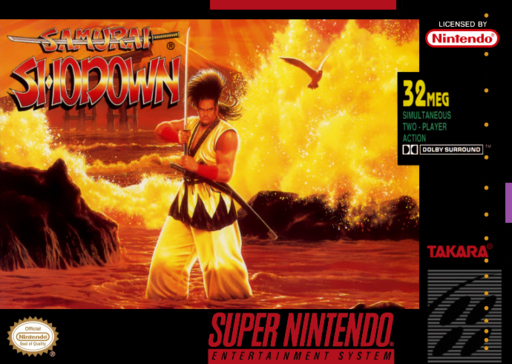
SNK's 1994 SNES port of the Neo Geo weapons-based fighting classic — Samurai Shodown brings the feudal Japan samurai fighter to SNES with 12 characters including Haohmaru, Nakoruru, and Earthquake, the weapon clash and disarm mechanics, rage mode that powers up attacks when health is low, and the game's characteristic one-hit-kill potential that distinguished it from contemporaries.
The Super Nintendo’s fighting game library defined console fighting games in the early 1990s in a way no platform before or since has matched for a single generation. When Street Fighter II arrived on SNES in 1992, it demonstrated that arcade fighting games could come home without meaningful compromise — and the audience responded by buying the game in numbers that proved fighting games were a mass-market genre, not an arcade specialty.
What followed was an extraordinary concentration of fighting game software on a single platform: multiple Street Fighter II versions, Mortal Kombat’s SNES-specific presentation choices, Killer Instinct’s technical showcase, and Samurai Shodown’s weapon-based gameplay. The SNES fighting game library is a comprehensive record of how the early-to-mid 1990s fighting game genre developed.
Street Fighter II Turbo: Hyper Fighting (SNES, 1993) is the version of Street Fighter II that most players spent the most time with, and the version that established the SNES as the console for fighting game enthusiasts. The Turbo Speed settings added a dimension to the classic Street Fighter II formula: faster combat at higher speeds created different match dynamics, different optimal combo timings, different character power rankings. The game that had been balanced around a single speed could now be played at up to eight speed settings, each requiring recalibration.
All twelve characters from the arcade game were present — the original eight World Warriors plus the four boss characters (Balrog, Vega, Sagat, M. Bison) who had become playable in the Championship Edition update. The SNES version’s six-button controller layout eliminated the need for the Genesis adapter or tournament sticks that earlier fighting game ports required.
Street Fighter II Turbo is where the SNES fighting game library begins.
Super Street Fighter II Turbo (SNES port of the arcade, 1994-1996 in various releases) is arguably the most technically complete Street Fighter II product. Four new characters — Cammy, Fei Long, Dee Jay, T. Hawk — expanded the roster to sixteen fighters. Akuma (Gouki) appeared as a secret character accessible through specific conditions, the first Capcom appearance of the character who would become a franchise fixture.
The Super Combo system — a super gauge that filled through combat and could be spent on high-powered special moves — added a resource management dimension to the game that Turbo lacked. Characters with strong Super Combos had a finishing tool that created match-end tension absent from the earlier games.
The SNES version’s audio quality suffered compared to the arcade original — the sound hardware limitations were audible — but the gameplay was accurate. Super Street Fighter II Turbo remains the version of Street Fighter II still played in competitive communities today.
The original Mortal Kombat on SNES was the notorious blood-free version — a decision that handed the Genesis version a clear victory and motivated Sega’s marketing campaign around the blood code. Mortal Kombat II (SNES, 1994) corrected this completely: the SNES version had full fatalities, all the gore, and superior control response compared to the Genesis port.
The SNES MK II is where the series’ second-generation design was best playable on home hardware. The roster expanded to twelve fighters, Sub-Zero and Scorpion received moveset differentiation, and the Friendship and Babality finishing moves provided comedy alternatives to the fatalities. The arcade-accurate presentation of MK II’s visuals — which the SNES handled well — made it the definitive home version of what many players still consider the best Mortal Kombat game.
Killer Instinct (SNES, 1995) was Rare’s technical showpiece — a game that used a custom compression chip to bring an arcade game’s visual quality closer to home hardware than previous ports had managed. The digitized graphics and distinctive combo audio (combo announcer calling out combo lengths during play) created an immediately recognizable aesthetic.
The infinite combo system — discovered by players shortly after release and never patched — created a competitive scene dynamic unique to this game. C-C-Combo Breakers became the counter to infinite combos, creating a technical layer of execution that made KI competitive play different from every other fighting game available on SNES.
Samurai Shodown (SNES, 1994) brought SNK’s Neo Geo weapon-fighting game to home hardware with a roster of twelve characters and the central mechanic that distinguished it from every Capcom fighter on the platform: everyone had a weapon, and the combat revolved around managing spacing at weapon range rather than the projectile-fireball exchanges that defined the SF2 era.
The Rage Meter charged as the player took damage, allowing a temporary power boost that could shift fight momentum. The weapon disarm mechanic — kicks that knocked weapons out of opponents’ hands — created catch-up potential for players losing a match. Samurai Shodown’s SNES version lost some visual fidelity from the Neo Geo original but preserved the game’s core design identity and gave players a genre alternative to Street Fighter that felt genuinely different.
.png)
.png)
.png)